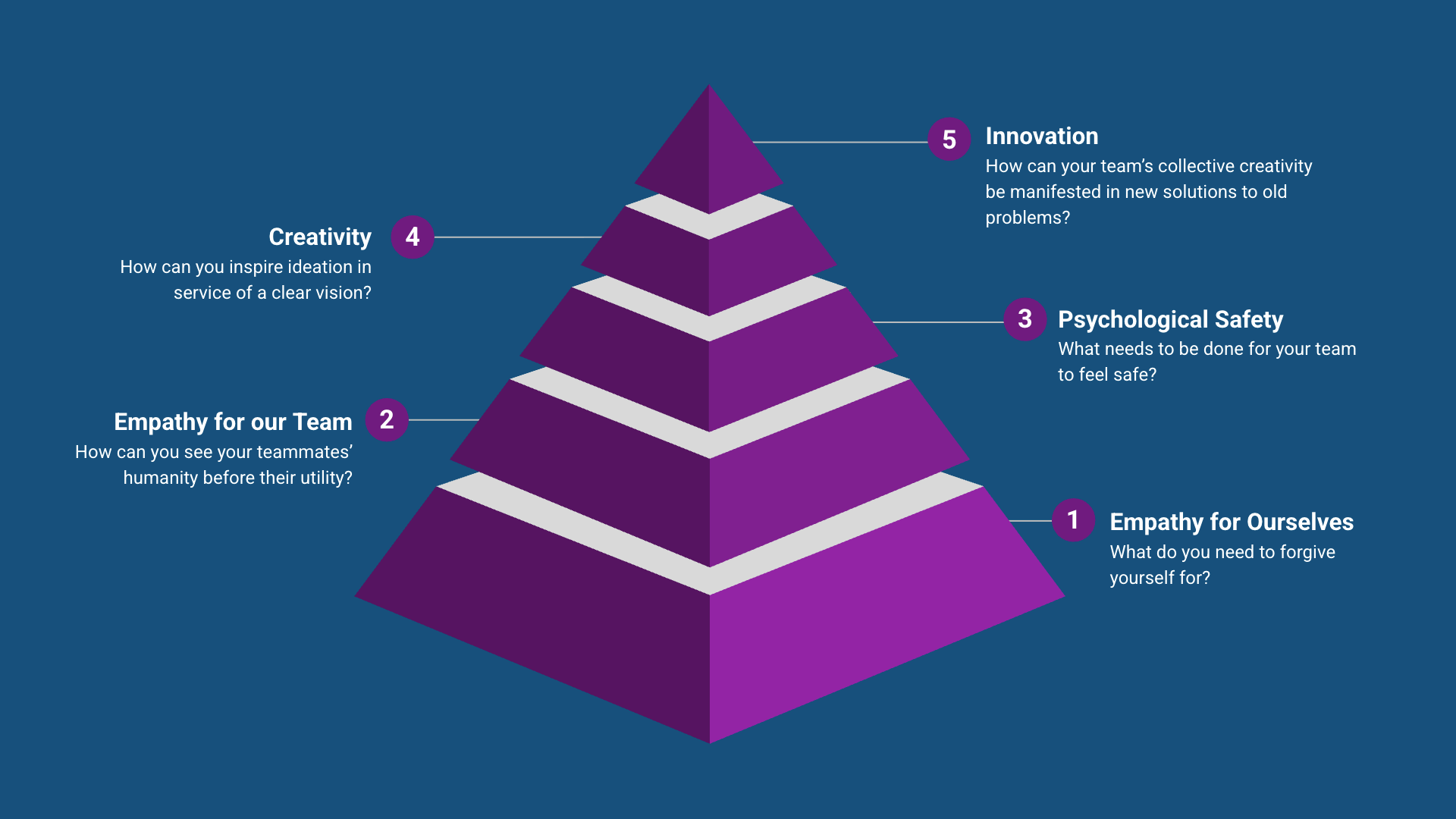
To empathize with our team we must first empathize with ourselves.
Psychological safety is the foundation for an effective team. This was a key finding of Project Aristotle, Google’s landmark two-year research project into effective teams. While each member of the team contributes to making every other person on the team safe, the team’s manager plays a crucial role. The work of building an effective team starts with us. Yet, we managers are often in our own way. Not because we want to be but because of our own self doubt, self ridicule, and internalized pressures that keep us from showing empathy to our team. As I coach executives and managers, I’ve seen how the difficulty of forgiving ourselves for the past prevents us from empathizing with ourselves and in turn with others. If that rings true, here are some questions you can explore to gain empathy for yourself:
What would a good friend say to me if I told them the story of what I can’t let go of?
Where could I go to be still long enough to remember what I like about myself?
When was one time I was truly happy with myself?
To foster psychological safety we must see our teammates’ humanity.
To be human is to be flawed. We make mistakes, we fall, we fail. We dust ourselves off and try again, we win, we inspire. If we do all this, then we each contain multitudes. That same multifaceted difficult complexity which can be maddening to deal with in others is the same complexity we hold in ourselves. We are each someone else’s maddening other to deal with. Being able to see the difficult complexities in yourself and still smile at them is a solid first step towards appreciating the same in your teammates, peers, and your own manager. If that rings true, here are some questions you can explore to gain empathy for the people around you:
When was a time I could even see myself being a “bit much” to deal with?
When was a time I appreciated someone doing their best, regardless of the outcome?
What have I convinced myself of about a person who I have a hard time with?
To be creative, people must be safe.
We get scared when we perceive a threat. This triggers a flight-or-flight response that causes the emotional center of our brain (the amygdala, if you’re curious) to override the creative thinking center of the brain (the prefrontal cortex). In fight-or-flight mode, we act on instinct, not on complex thought. It’s 1 to 1. Not safe : not creative. By extension, not creative : not solving problems well. Since a business only grows to the size of the problem it can solve, how big will your company grow if your people aren’t safe? If that rings true, here are some questions you can explore to make your team feel safe:
Who on my team doesn’t feel comfortable speaking up and how can I get their input another way?
Do I allow people to get interrupted when they’re talking? (Oddly specific, but hearing people without interrupting is a key ingredient to safety. Here are some other ways to make your team safe.)
In what context are the people on my team able to do their best thinking?
To innovate we must manifest creativity.
When we are safe to think and create, imagination flourishes. Ideas proliferate. Innovation is then manifesting creative solutions into reality. For your team to drive innovation, they must have first had the safety and freedom to ideate and then the resources and structure to implement. Implementation of something totally new is usually a process of failing and learning. Implementing creative solutions is not about one attempt. It is about knowing each iteration was just an attempt and preparing to learn from it before you even began. If that rings true, here are some questions you can explore to drive innovation:
What structures have I put in place for my team to learn from their iterations?
Who on my team, including myself, thinks we’ll get it right on the first try?
Knowing we must iterate to improve, how can we learn with the least effort spent on each iteration?